An orchid dreams... | An Interview with Michaela Pegum
An orchid dreams they are a woman, who dreams she is becoming the ocean with skin like radiolaria, who dream they are a statue of a small rare bird, who dreams they are a cloud of perfume…
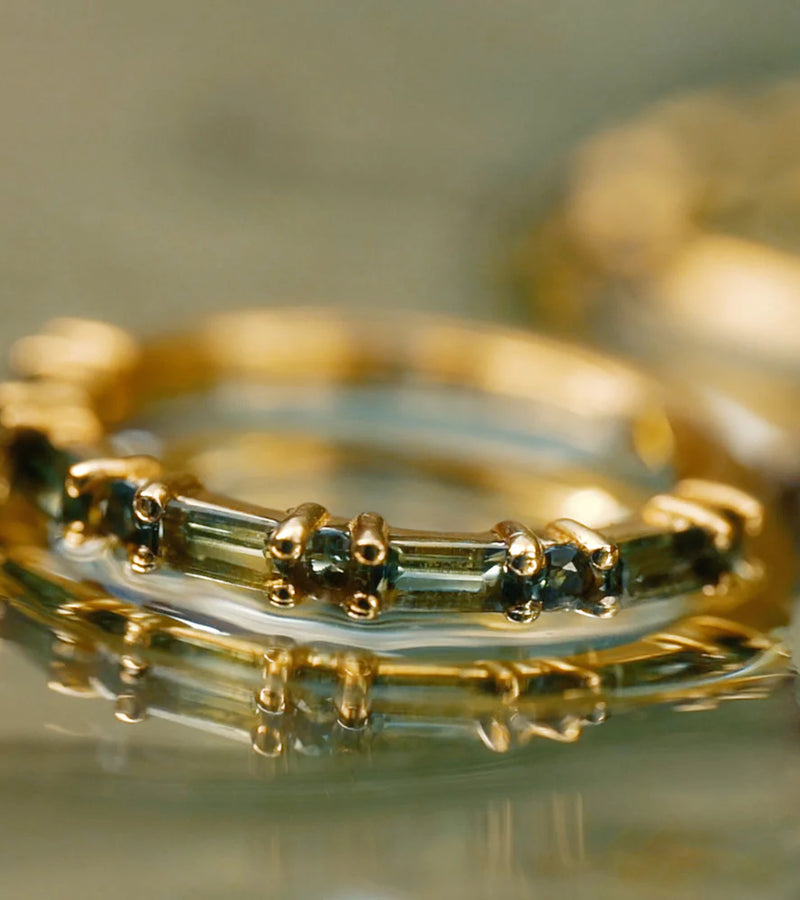
From October 19-31, 2026, we're presenting Michaela Pegum's latest exhibition of contemporary jewellery, 'An orchid dreams...' in our Russell Place windows. Showing as part of the Radiant Pavilion Contemporary Jewellery & Object Biennial, Pegum extends on her acclaimed 2025 body of work, Familiars, to explore new wearable forms with discreetly embedded crystals and gemstones.
In this conversation, Michaela talks about the dreams that inspired this show, the material continuum behind them, and what she hopes a passer-by with no context might feel when they meet the work in the window at Russell Place: held, curious, and perhaps, in her words, a sense of deep peace.

PO8: The exhibition synopsis you shared with us opens with a chain of dreams: an orchid dreaming she is
a woman, a woman becoming the ocean, a statue of a rare bird, a cloud of perfume. Where did that
sequence begin for you, and which of those transformations came first?
MP: A chain of dreams is a lovely way to put it. This idea really came from my own experiences in dreams
historically, and a reflection on how dreaming can be a way of uniting with the world around us. Central to
my work is exploring how we can feel and understand our continuum with the world, something that teases
apart the stronghold of categorical thinking, which can weaken our sense of compassion and narrow our
perception. So the idea of becoming ‘other’ as a form of expansion and an act of empathy, is something
I’ve been thinking about for many years. We know that other animals dream, and the suggestion that plants
and other forms we consider inanimate might dream is an invitation to identify and thus empathise with
them, and also to consider they might have their own inner worlds.
I went open water scuba diving last summer, and found it a profound experience. Drifting with the underwater swells, and being mesmerised by the intricate surfaces of the rocks and sea life, made a deep impression on me, and later I did actually dream I was becoming the ocean, and my skin was turning into a coral or radiolaria-like substance. Some time before this I dreamt that I was becoming the sky, becoming totally ephemeral. I wake from these sorts of dreams feeling transformed. The other life-forms and objects in the passage are all things I live with in my home, and that I gaze upon and converse with in a wordless way, every day. There is a dynamic between levels of scale in the passage as radiolaria are microscopic organisms, and I was interested in this as another way of shifting perception, and moving between worlds. The cloud of perfume was another way of taking this shift further, into the realm of scent rather than form, it also points to our ephemerality or mortality and thus another transformation, through metaphysics and the scales of time.

PO8: Silica runs through everything in this body of work: plant cells, animal bone, the exoskeletons of
radiolaria, glass ornaments on a mantelpiece. When did you first notice that thread, and what changed
in your making once you did?
MP: I’ve always been very drawn to glass and have been experimenting with it in different ways over the past
few years. Recently, I was reading a book titled ‘The Songs of Trees’ by David George Haskell, and learnt
that plants contain silica, which gives them their structural strength amongst other things, and this surprised
and interested me. This was about the same time I was scuba diving and thinking a lot about sea life, and
also developing the ‘re-constructed’ glass substance that I am working with now, so I felt compelled to learn
more about how far its reach actually stretched. It’s an incredibly abundant substance traversing earth,
animal, mineral, plant, and of course human cultural, domestic, industrial and scientific objects. I loved that
this material I was already working with to materialise my ideas involving transformation and becoming, was
so deeply woven through all sorts of substances and forms of life; a genuine material continuum. Since
then, I’ve been incorporating quartz as a crystalline form of silica into my work, and mica as a silicate
mineral, as well as continuing to develop my casting processes. Prior to this I was mostly working with
electroforming, so this new material and technique has allowed me to explore form in very different ways.
Like my electroforming though, this process is still driven by the desire to create hybrid substances.

PO8: You work with what you call re-constructed glass: ground glass bound with a bio resin, a material
with an echo of the reconstructed stone that has appeared in art and contemporary jewellery. What
drew you to working with glass in this form rather than blown or cast, and what does the material
allow you to do that solid glass wouldn't?
MP: I began exploring glass through casting first, and then did some lampwork, which was fascinating. It was
hard for me to integrate these techniques into my practice though. The core of my practice is probably the
development of material languages, I am deeply interested in how form and substance can communicate
beyond representation. This means I work intuitively and experiment a lot to try and uncover these more
abstract and perhaps subconscious methods of communication. I found that the processes of working with
casting and molten glass were too prohibitive for me in the end, as I need to spend a lot of time with my
materials in a hands-on way, and these processes don’t always allow for that. There is a lot of infrastructure,
cost and sometimes the support of other people (in glass blowing) required to allow you to make contact
with the process, which didn’t make it conducive to working in a continuous, spontaneous and iterative way
for me. In working with the glass and bioresin in my studio there is more scope for experimenting with
mould making and the creation of positives that aren’t required to melt away as they would be with molten
glass casting. I can also intervene in the process of curing sometimes, and include substances that wouldn’t
be able to cope with the heat involved with molten glass. All in all it allows me to feel closer to the process,
and work with it in experimental ways.

PO8: The show moves between sculpture and jewellery. How do you decide when a form wants to be
worn on the body and when it wants to stand on its own, and does the boundary between animate
and inanimate feel different at each scale?
MP: I feel for many of my sculptural works, they have a place inside the body before they emerge and I can
sense them before they do - these works have a wildness of form to them that needs to be honoured for the
work to really live, and it would be difficult to do that when working with the necessary parameters of a
wearable piece. When I make jewellery, I generally take an element or an aspect of a sculptural motivation
and then continue to pare it back and have it come into conversation with those design considerations
inherent in the process of making forms for the body. In this way the jewellery has a kind of singularity to it
when compared with the sculptural forms. I do think a sense of animacy varies across the scales. I make
jewellery to become a part of someone, or ignite a transformation in them, like an ‘aspect’ or a trigger, or
portal, whereas the sculptural work I make to be in conversation, or communion with. Thats how I see it at
the moment anyway, it’s a rich and evolving paradigm for me.
PO8: The work proposes a shared universal body, a flow of becoming between forms of life and objects
of the imagination. What do you hope someone feels when they encounter the pieces in the window
at Russell Place, particularly a passer-by who meets them without any context?
MP: My hope would be for the work to hold them, and pique their imagination and curiosity. I also hope that the work might express a continuity and sense of transformation across the objects that feels inclusive and
expansive for the viewer. Imagination, beyond whimsy is the way in which we connect to things beyond
ourselves, and in that there is evolution, adventure, and potentially, when we consider those greater
universal spheres of becoming and connection, a sense of deep peace I think.
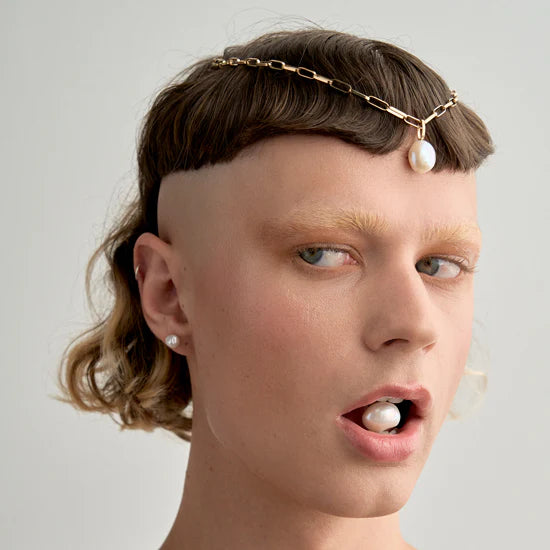
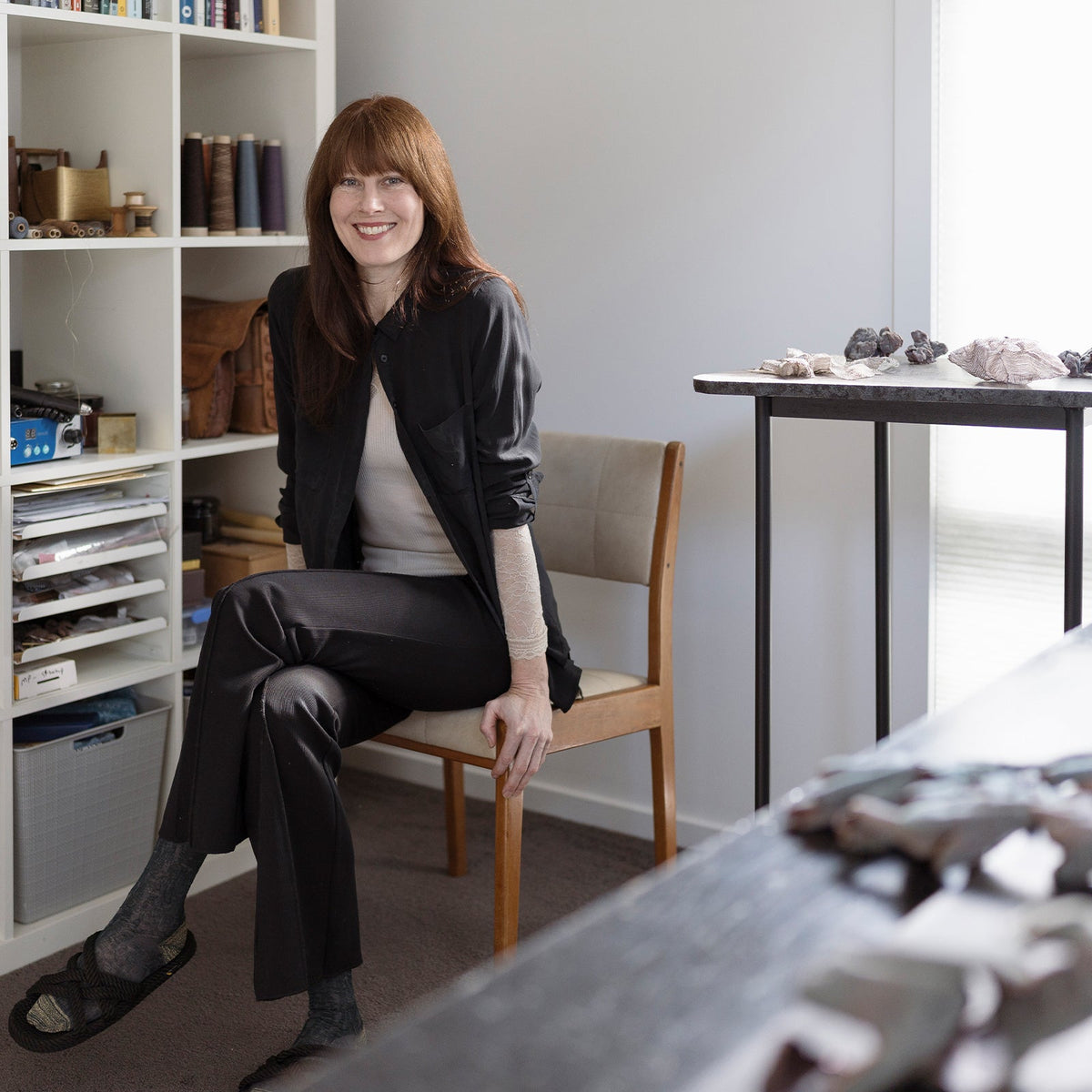
Hero image of Michaela Pegum by Astrid Mulder, courtesy of the artist.