Introducing Ara Dolatian: Light for the Table
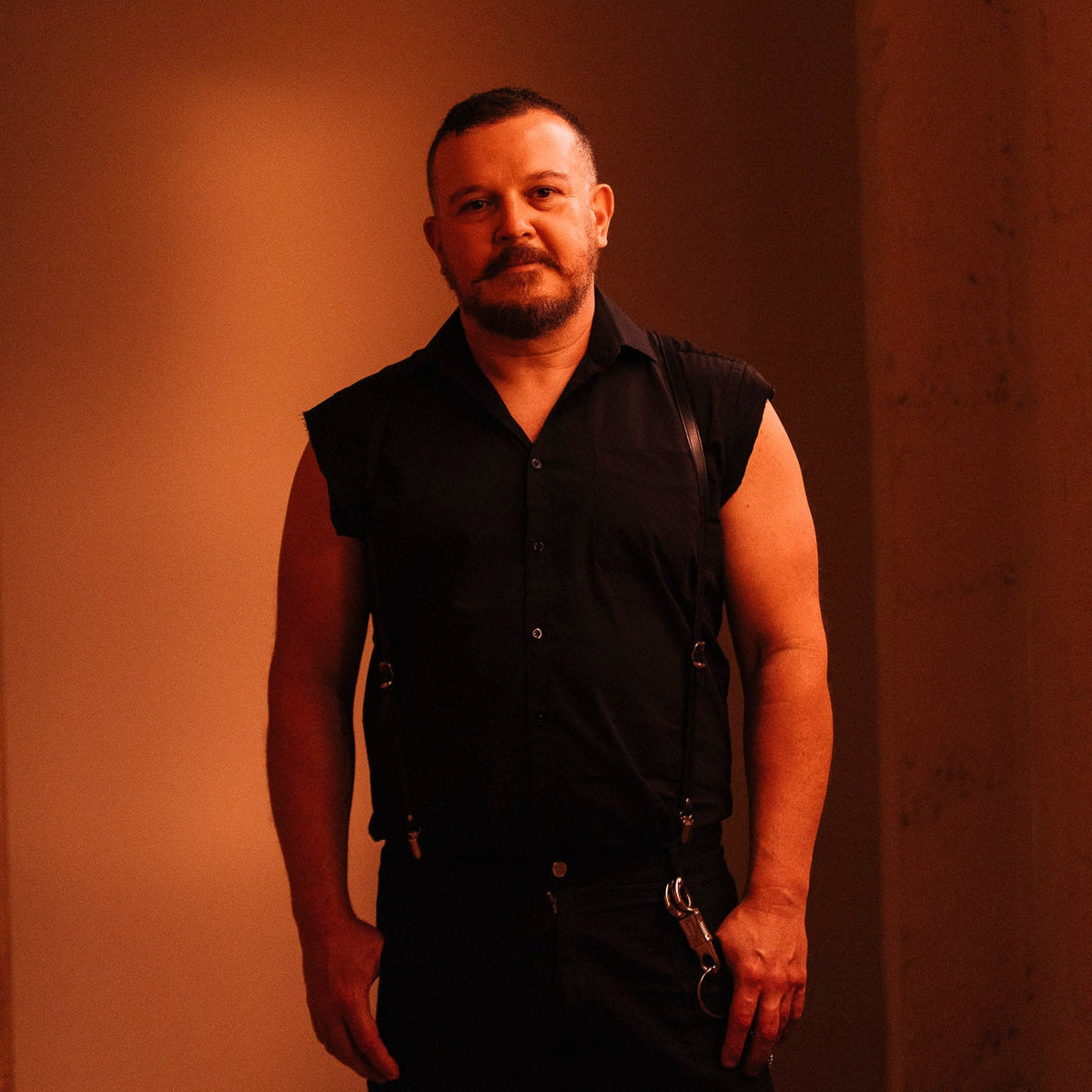
Melbourne artist Ara Dolatian joins Pieces of Eight with Quevara, a series of sculptural ceramic candelabras and vessels finished in a deep gold lustre. Gallery director Melanie Katsalidis spoke with him about dinner parties, a secret rock collection and why the most important moment is the first one.

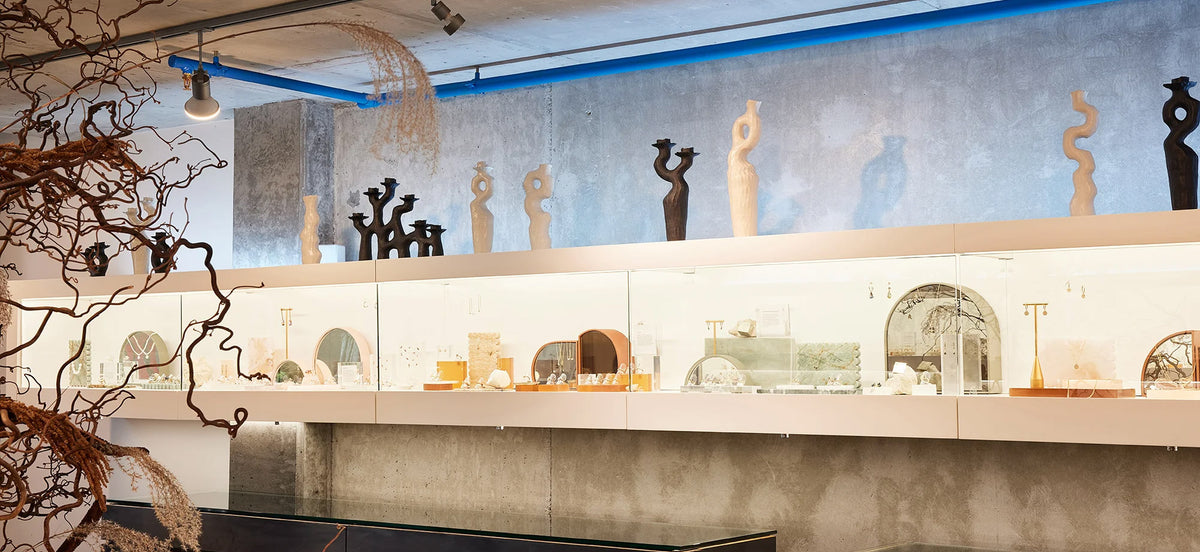
Some objects ask to be noticed. Ara Dolatian's ceramic candelabras are made to do exactly that. "I really wanted something that's not shy as a centrepiece," he says. "Something quite loud, for people to walk in and say, what is that thing on your table?"
That thing on the table is Quevara, the design label Ara runs alongside his fine art practice. This month a body of work made especially for Pieces of Eight arrives in the gallery: candle holders, candelabras and a vase in a molten gold and bronze lustre, in the lead-up to our exhibition Yours Truly.
A life in several chapters
Ara came to Melbourne at sixteen and went straight into Year 11 and 12 after an intensive English course. "It was difficult, but it was also quite fun and exciting," he recalls. In his twenties he ran a fashion label under his own surname: tailored, androgynous, black and white pieces made in small runs, cut for men but designed to be worn by women too, at a time before androgynous clothing was mainstream. Every fabric and maker was local, from Fitzroy, North Fitzroy and Brunswick. When those makers began to close, so did the label.
He went to university at thirty, studying sculpture at RMIT and then a Masters in Environment and Planning, and began his art practice at thirty-five. "Starting later, you have some previous experience," he says. "It was a lot less daunting." Since then his ceramics have won the Incinerator Art Award and been shown nationally and in New Zealand, where Scott Lawrie Gallery describes them as "magical amulets from some forgotten realm".

Quevara was born from a simpler wish: to make something for himself. "I enjoy hosting dinner parties for friends," Ara says. "For me it's a ritual. It's an act of love, getting your friends together and having these conversations."
Keeping design and art as two separate streams also gives him freedom, and a way to reach people who might feel shut out by the art world. "People find design a lot less intimidating," he says. "They don't need complex words to talk about a candle holder with their friends."
Words of love
Those conversations live on in the titles. You're My Rock, Lover, My Love, Dream, She Looks Like a Supermodel: each is a phrase we use to describe and adore the people closest to us, and many are quietly funny. Humour matters to Ara. "Life in general at the moment is so serious, and politically everything is so intense," he says. "I think it's really important for anyone to have some time for yourself, step away and have a bit of fun. This is a really nice escapism."

That lightness sits beside a weighty history. Ara's father is Armenian; his grandparents survived the Armenian genocide and settled in Baghdad, where his father was born. His mother is Chaldean, one of Iraq's Indigenous Christian peoples. Ara acknowledges this history in his art practice, but never to shock. "I give people just a little bit of information," he says. "I feel it's also the reader's responsibility to learn about these topics."
Shaped by hand, struck with stone
Each piece is made without tools. "I just use my hands to shape them," Ara explains, working with gravity and going "back and forth" until the form feels finished. Some appear caught mid-melt, like wax frozen in time, and the references shift freely between brutalism, abstraction, the Baroque and the Victorian. "There's no limitation on how the final object may look," he says. "That freedom is exciting, because it's not something I can do with my art practice."

The rock-like pieces carry a story he shared with us for the first time. Ara collects coarse, sharp stones from central Victoria, the ones that look like spearheads, and keeps them under his desk. He then strikes the clay with them to build the surface. "It's actually quite physical," he says. "I think I kept it a secret, but now I think, why not share it."
He works without one eye on trends or the market. "I find it helpful not to think about it, and just do my thing in the studio and make the work I want to make," he says. "We do our art because we have to. For me it's really important to enjoy my practice."
Gold, blue and the ritual of light
Gold and lapis blue run through all of Ara's work. Lapis, he explains, was once more precious than diamonds, carried along ancient trade routes from Afghanistan to Greece and India, and often used to depict eyes as a way of connecting with the gods. Gold, bronze and copper speak of the artefacts those cultures left behind. "It's to do with artefacts and ancestry," he says.

The candle itself carries meaning too. "I'm not religious, but I grew up with both the Catholic and Orthodox church," Ara says. "There's something about the ritual of burning candles and incense, even frankincense, that still resonates with me. It does something that's quite difficult to express." He has begun exploring these inherited rituals in a photography project, gathering objects tied to his parents' heritage on a single table: incense, candles, pomegranates and coffee. It is work he plans to return to next year.
The first encounter
As a collector of jewellery and brooches himself, Ara understands how objects take on personal meaning. "You always remember the story behind the designer," he says. "It becomes related to the object, and you wear it, and it's quite personal."
Yet for his own work, he hopes the first response comes before any story at all. In a gallery filled with precious metal, his lustre surfaces are easy to mistake for cast bronze or gold at first glance, and that moment of encounter is exactly what he hopes for. "It's really important for the viewer to make a connection with the object first, without even knowing anything about the artist," he says. "Every piece is special and handmade, but that initial experience between the viewer and the object is so important."
Light one, and see what it does to the table.

Ara Dolatian's Quevara collection is now available in the gallery and online. See it in person at 28 Russell Place, Melbourne, and at the opening of Yours Truly on Thursday 12 November, 6 to 8pm.