Emma Coulter for Tidal Wave: The Body as Architecture: Painting Light onto Baroque Pearls
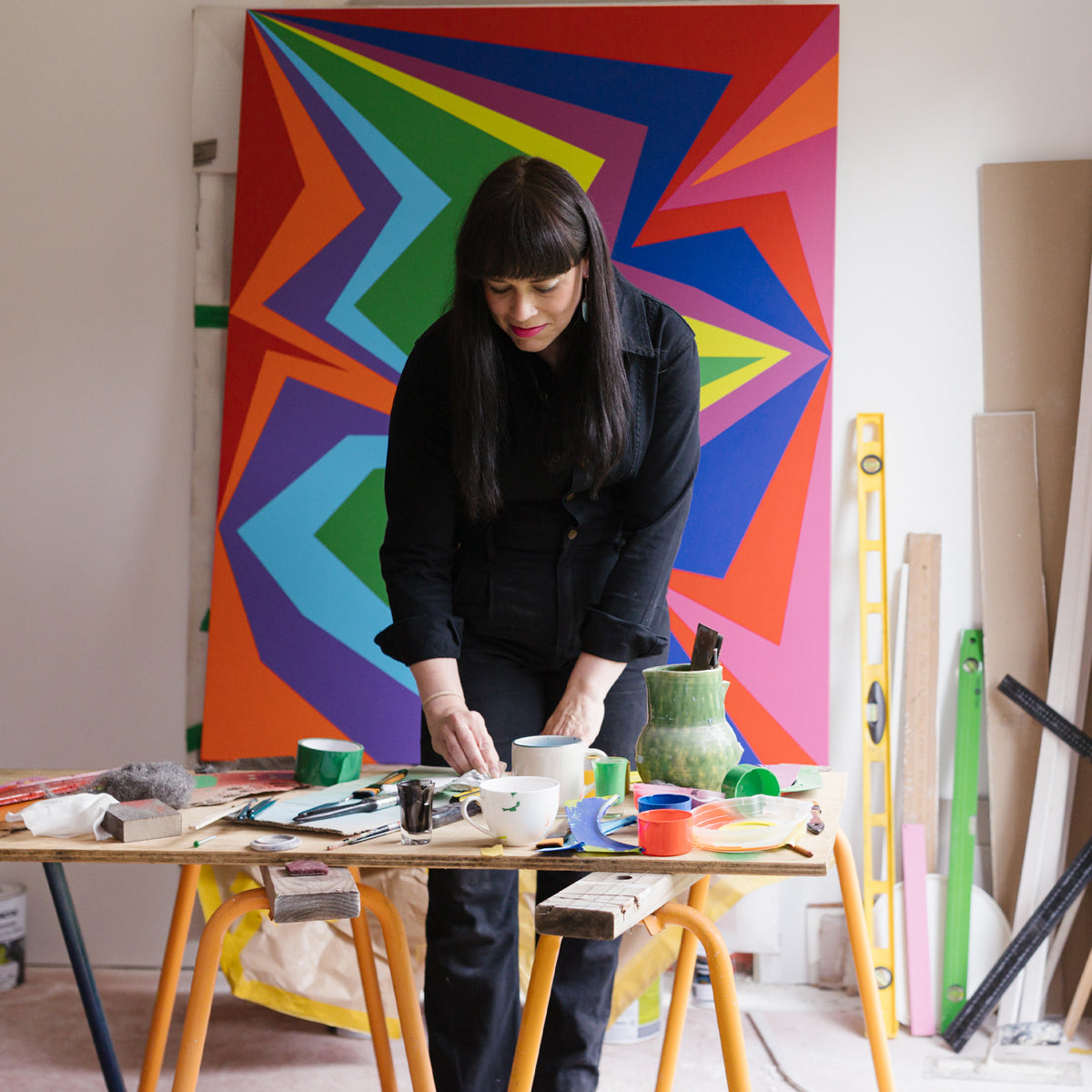
For an artist known for large-scale public works where colour unfolds across architecture and civic space, the shift to jewellery might seem like a leap — but as Emma Coulter explains, it's less a departure than a distillation.
In this conversation about her work for our Tidal Wave exhibition, Emma unpacks how the baroque pearl's natural irregularity disrupted her usually rigorous, pre-visualised process, opening up a more intuitive dialogue between painted colour and the gem's own iridescence. What emerges is a meditation on scale, intimacy and time: how an artwork designed to be worn on the body — catching light, moving with the wearer — can carry the same conceptual weight as a mural encountered by thousands, just experienced one person, one gesture, at a time.

PO8: Your practice is built around an exhaustive pre-visualisation process, you test and eliminate before a single mark is made. How did working on the curved, irregular surface of a baroque pearl disrupt or liberate that process?
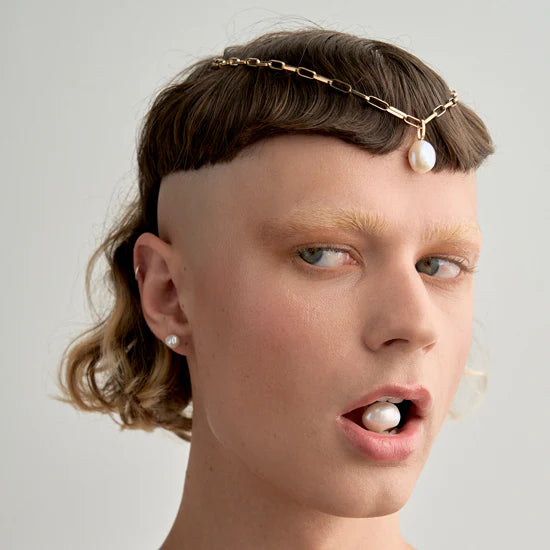
EC: My process isn't exhaustive so much as it is iterative. It involves a great deal of thinking, testing and refinement before a final work is resolved, much like the process of making fine jewellery. Rather than approaching the pearl as a blank surface, I treated each baroque pearl as a unique sculptural form and a site for investigating abstract colour systems. I was conscious of preserving the pearl's natural beauty and irregularity, so instead of covering its surface, I developed small chromatic insertions that sit in dialogue with it. The asymmetry of each pearl challenged my usual geometric logic, encouraging a more intuitive response where the natural form became an active collaborator in the composition rather than something to be controlled.

PO8: You've described colour as a kind of democratic, non-verbal language accessible to anyone. Pearls carry their own deeply coded colour symbolism, lustre, overtone, iridescence. How did those two colour conversations meet in your work for this exhibition?
EC: I've always approached colour through abstraction. While my work is informed by research into perception and spatial systems, colour also operates on a deeply intuitive and emotional level. It's a universal language that can be experienced without explanation. The baroque pearl introduced another chromatic register. That is, its natural iridescence is constantly changing, responding to light and movement in ways that no painted surface can fully predict. Rather than competing with those qualities, I wanted the painted colour to enter into a reciprocal exchange with them. The chromatic insertions don't override the pearl's own colour; they amplify it, creating subtle shifts where painted colour and natural iridescence continually influence one another. That dialogue between the intentional and the organic became central to the work.

PO8: Much of your work is designed to be encountered repeatedly over time, embedded in the fabric of public life. How do you think about an artwork that will be worn on the body, a surface that moves, catches light, and appears only in intimate proximity?
EC: Although these works exist on an intimate scale, they continue my interest in colour as something experienced through movement, light and the body. My public artworks unfold as people walk through space; these pearls unfold as the wearer moves through the world. The body becomes the architecture for the work, and the changing relationship between the pearl, colour and light creates an experience that is never fixed. I like the idea that these pieces carry the same conceptual concerns as my larger works, but in a form that accompanies everyday life. They invite repeated encounters, revealing new chromatic relationships over time while transforming the act of wearing jewellery into an experience of living with art.

Visit us at 28 Russell Place, Melbourne, to experience Emma's colourful creations for Tidal Wave. Now showing until August 29, 2026.
Read more

For Tidal Wave, Melbourne artist Kate Tucker was invited by gallery director, Melanie Katsalidis, to work at an unusually intimate scale. Known for a practice that pushes painting beyond the flat ...

Tidal Wave opened to a full house at Russell Place, unveiling nine remarkable responses to the painted pearl. Guests joined the artists for an evening of jewellery, art, Coastal Gin & Tonics, f...