
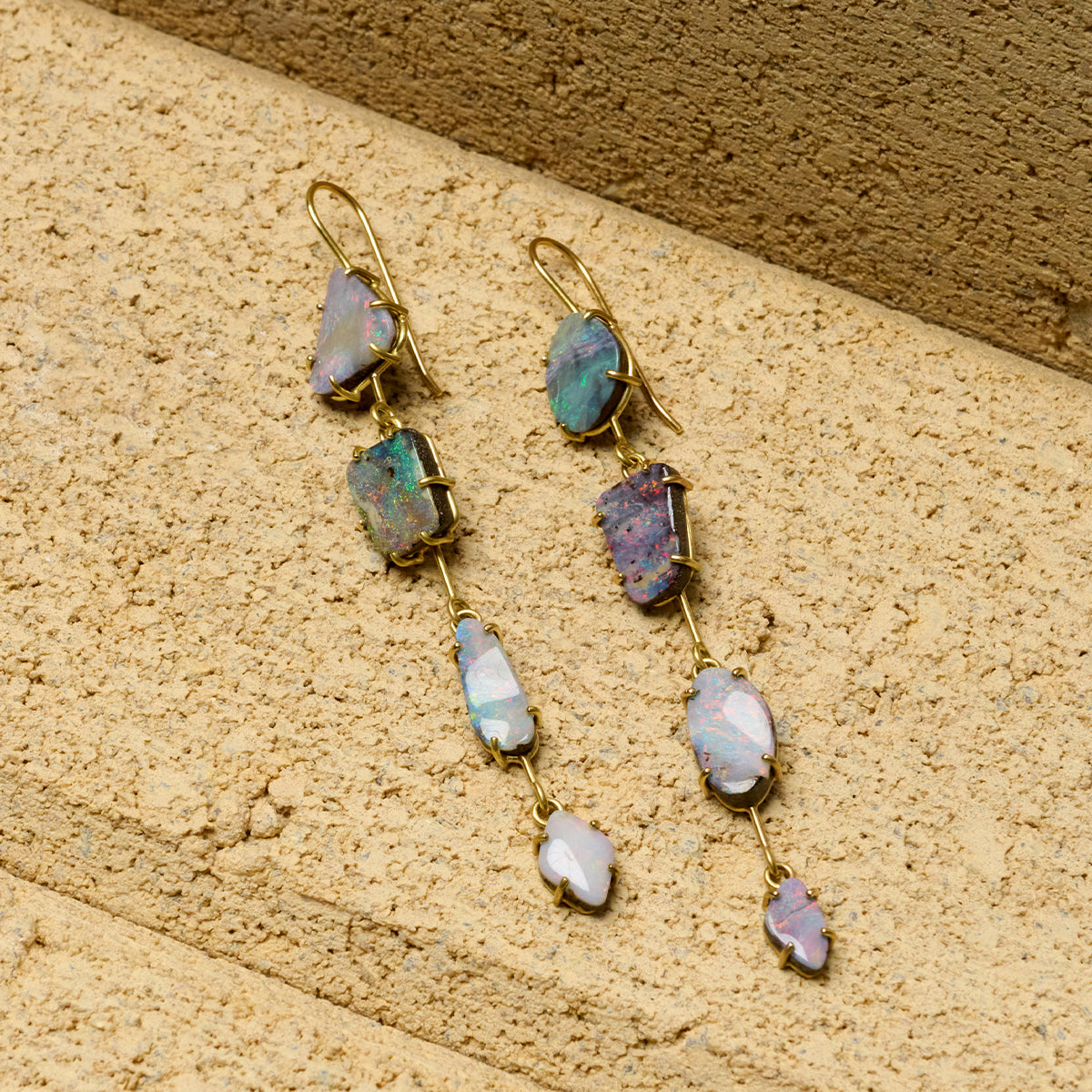
Boulder Opals: A New Capsule Collection
Boulder opal is not the opal most people picture. It is not the milky white stone, and it is not black opal. It comes out of ironstone in the west of Queensland, and it is cut with that ironstone still attached. The deep brown you see behind the colour is not a backing added later, and it is not a setting: it is the rock the opal formed in. That is the whole appeal for me; both the colour and the ground it came from, held together in one stone.
What is opal?
Opal is not a crystal. Almost every other gemstone you can name - from sapphires to diamonds, or emeralds - is built on a repeating lattice, and its colour comes from what is in that lattice.
Opal by contrast is composed of silica and water, set down in tiny spheres. When those spheres happen to be the same size and are stacked in an orderly way, they break white light into its colours the way a drop of oil on wet ground does. That is the play of colour: not a pigment, but a structure. Tilt the stone and the structure shows you a different colour, because you are looking at it from a different angle.
This is why no photograph of an opal is quite honest; the camera fixes on one angle, yet the stone has hundreds.
This is also why opal is so varied. The size of the spheres dictate which colours appear: smaller spheres give blues and violets, larger ones let the greens, oranges and reds through. An opal with red in it is rarer than one without, and that is the reason red fire has always commanded the highest prices. I tend to buy for blue and green, partly because that is the palette I love, and partly because a very good blue-green stone costs a fraction of a red one, that is no more beautiful.
 Australian opal
Most of the world's precious opal comes out of Australia. It is plucked from one enormous ancient basin that runs down the middle of the continent, which was an inland sea one hundred million years ago. When the sea drew back it left behind hundreds of metres of sediment, and over a very long time silica rich water moved down through that sediment, settled into any gap it could find, and slowly set.
Where it eventually set determines what kind of opal you get. In the pale sandstone of Coober Pedy in South Australia it set as light opal; the white and crystal stone most people picture. In the dark claystone of Lightning Ridge in New South Wales it set as black opal. And in the Queensland fields of Winton, Quilpie, Yowah and Opalton, the silica found its way into ironstone: hard, rust brown concretions that had formed in the mud, cracked, and left room for the opal to fill the cracks. This became boulder opal.
The name is literal: the ironstone is pulled from the ground as boulders, some the size of a fist, some the size of a car, and the opal runs through them in thin seams and veins. A cutter opens the boulder, finds the seam, and follows it. The opal is often too thin to stand alone, so it is left on its ironstone, which is not a compromise, it is the very point. The ironstone gives the colour a dark ground to sit on - the same way black opal's claystone does - and it gives the stone a toughness that solid opal does not have.
Winton
All the stones in this capsule collection are from around Winton, in central western Queensland. I bought them directly from a miner I met while I was in Queensland buying parti sapphires in Rubyvale. This is how most of the best stones I have worked with have come to me: not through a catalogue, but from a conversation with the person who dug them up.
Winton opal has a character of its own. The ironstone there tends to be a deep chocolate brown, and the colour that sits on it runs strongly through blues and greens, often with a gold flash that appears and disappears as the stone moves. Some stones from the field carry a thin skin of colour across the whole face; others show the colour in veins, with the ironstone running through it like a map. Both are true boulder opal and I have used both.
 The Capsule
Every stone within this collection is older than anything else you will wear. Ruminate on that for a moment. What an honour and a privilege.
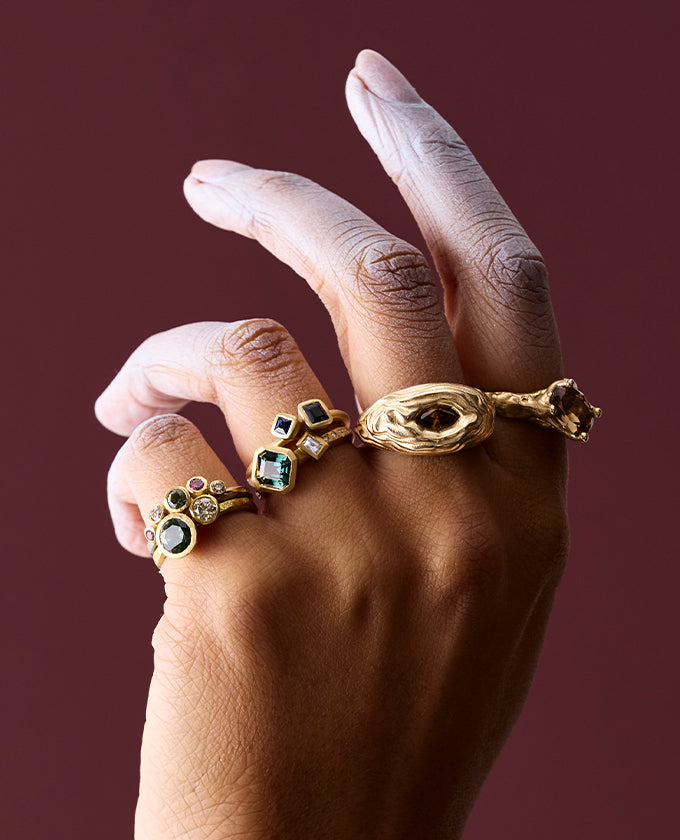
The second thing to note is that no two are the same shape. Boulder opal is cut to follow the seam of colour through the ironstone, not to a calibrated template. The stone decides the outline. So nothing in this capsule is a matched pair in the usual sense. Where I have used several stones together, I have chosen them to share a palette, then let each maintain its own outline.
Choosing
Buying opal from the miner means buying it before it has been tidied up for you. Some of the stones I brought back were obvious. Most were not, and the ones I kept coming back to were the ones that did something as I turned them: a green that went blue at a certain angle, a flash of gold that was there and then was not.
Those are the stones in these pieces. I chose for movement first and for colour second, because colour is what a photograph shows you and movement is what you live with. A boulder opal on the hand or at the ear is never quite the same stone twice in a day, and that is the quality I wanted to build around.
I also chose stones with a clean, stable face. Some opal, from some fields, is prone to crazing, a fine network of cracks that develops as the stone dries out over years. Queensland boulder opal has a good reputation for stability, and it is one of the reasons I am happy to make pieces from it that are meant to be worn every day rather than kept for special occasions.
 Living with opal
Opal is softer than the stones most people are used to wearing, appreciably softer than sapphire or diamond, and it deserves to be treated as what it is. That does not mean it is fragile. Boulder opal in particular, with its ironstone behind it, stands up well to daily wear. It means a few plain habits: take it off for the gym, the garden and the beach; keep it away from ultrasonic cleaners and harsh chemicals; wipe it with a soft cloth and, if it needs more, warm water and a drop of mild soap. Water will not hurt it. Heat, knocks and abrasives will, over time.
Worn with that much care, which is not much, an opal outlasts its owner. Given where it has already been, that seems the least it can do.
On looking
Photographs of opal are honest about the colour yet lack information about its movement. What they cannot show is the way the same stone goes from green to blue as you turn your head, or the moment the gold flash appears and disappears.
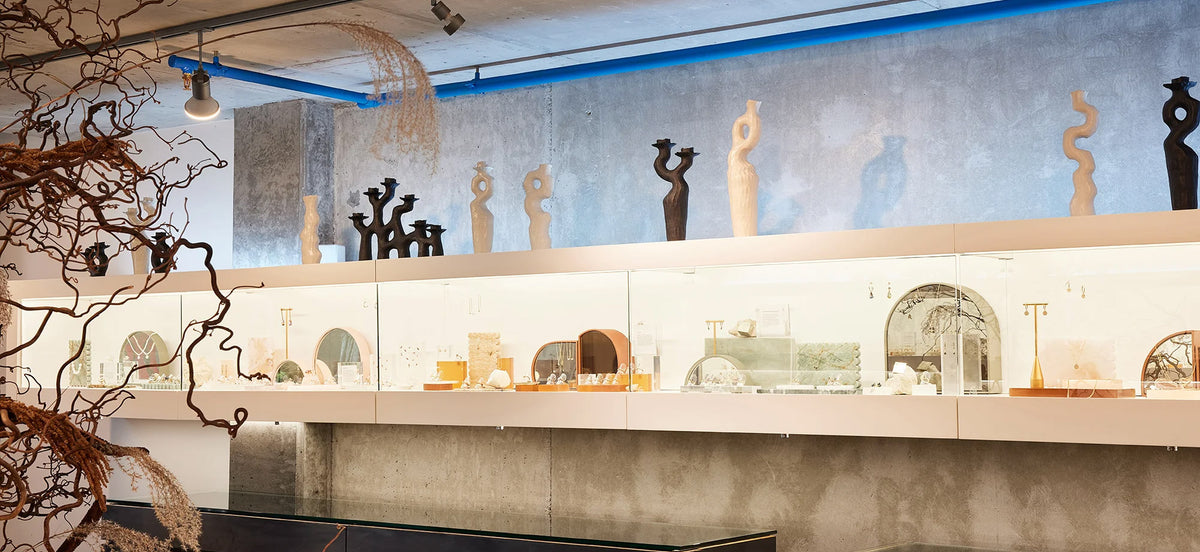
Come and turn them in the light. All four pieces are waiting for you at the gallery, 28 Russell Place, Melbourne.
Read more

During a recent visit to MONA, our founder Melanie experienced the evocative new site-specific installations by Tasmanian artist Heather B. Swann: Cabinet of knowing and weeping and the Cabinet of...

Our latest Australian sapphire rings make a case for a different kind of forever: not the conventional, expected, white diamond forever - a more particular, discerning one.