



The Devil, Still In The Detail: Inside William Llewellyn Griffiths's Studio
The buskers arrive with the working day. From this height you can hear all of them, and after a year in this studio, William Llewellyn Griffiths can tell you exactly how many songs each of them knows.
The timing of the studio was somewhat serendipitous. The artist had been away travelling, first to Geneva’s gem fair and then to Hungary to study enamel painting. When he returned to Melbourne, the landlord asked whether he still wanted the space. He said yes, more or less on the spot.
It is a modest room, but one perfectly suited to the scale of his practice. Here, the work is measured in millimetres.

Three benches and a very old lathe
There are three jewellery benches in the studio. One is William’s, another is used by the person who assists with clean up work, while the third is dedicated entirely to engraving. Moving an engraving setup, William explains, is an afternoon you do not get back.
William is comfortable working with both old and new technologies. There is a laser engraver in the studio, and he uses CAD modelling, 3D printing and scanning when they serve the work. But the piece of equipment he is most keen to show us is a watchmaker’s lathe, well over 150 years old and one of a small collection he has acquired from the watch trade. He uses these machines to turn the minute components that become part of the mechanisms within his jewellery.

His preference for older equipment is not driven by nostalgia. It is not the modern machines that fail, he says, but the computers that talk to them.
"It's not so much the tech. It's the computer, and the things in the computer that talk to it, that go wrong."

The library
The most revealing object in the studio is not a ring, but a wall of moulds.
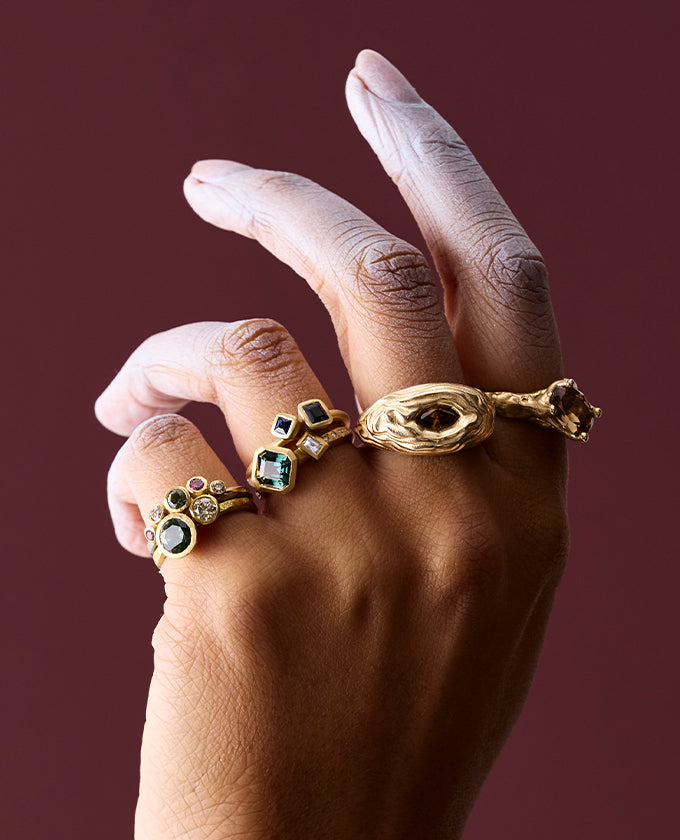
Over nearly fifty years, William has built a library of small forms: scrolls, dentils, corbels, garlands, ribbons and tiny clawed feet. Each began as something he modelled or carved for a particular piece, then cast in metal and moulded so that it could be called upon again. When he designs, he is often assembling as much as drawing, pulling waxes from this library, bringing different elements together, then carving whatever the new piece still requires.
What makes the library particularly fascinating is where these elements originate. William draws from almost everywhere: architecture, furniture, historical objects and, occasionally, other jewellery.
The tiny feet, for instance, were inspired by the finely fluted legs of Regency furniture. The shoulders of one ring came from a Medieval ring he encountered, while the dentils, those small repeating blocks that sit beneath a cornice, were borrowed from architecture. Once you recognise them in his settings, you begin spotting their counterparts on buildings all the way down the street. The bows can be traced to a large diamond bow brooch he saw in Geneva and has clearly never quite stopped thinking about.
"I quite often see something on something else. It might be a bit of furniture, it might be a building, it might be a piece of jewellery."

Enamel, and a jar the size of a thimble
Enamel has fascinated William for years, and last year that interest took him to the Hungarian countryside to study painted enamel. For ten days, he worked alongside an enameller in a centuries old house, stooping through its tiny rooms and sharing meals cooked by his host between lessons.

The mechanisms
The pieces William is perhaps best known for are those that move.
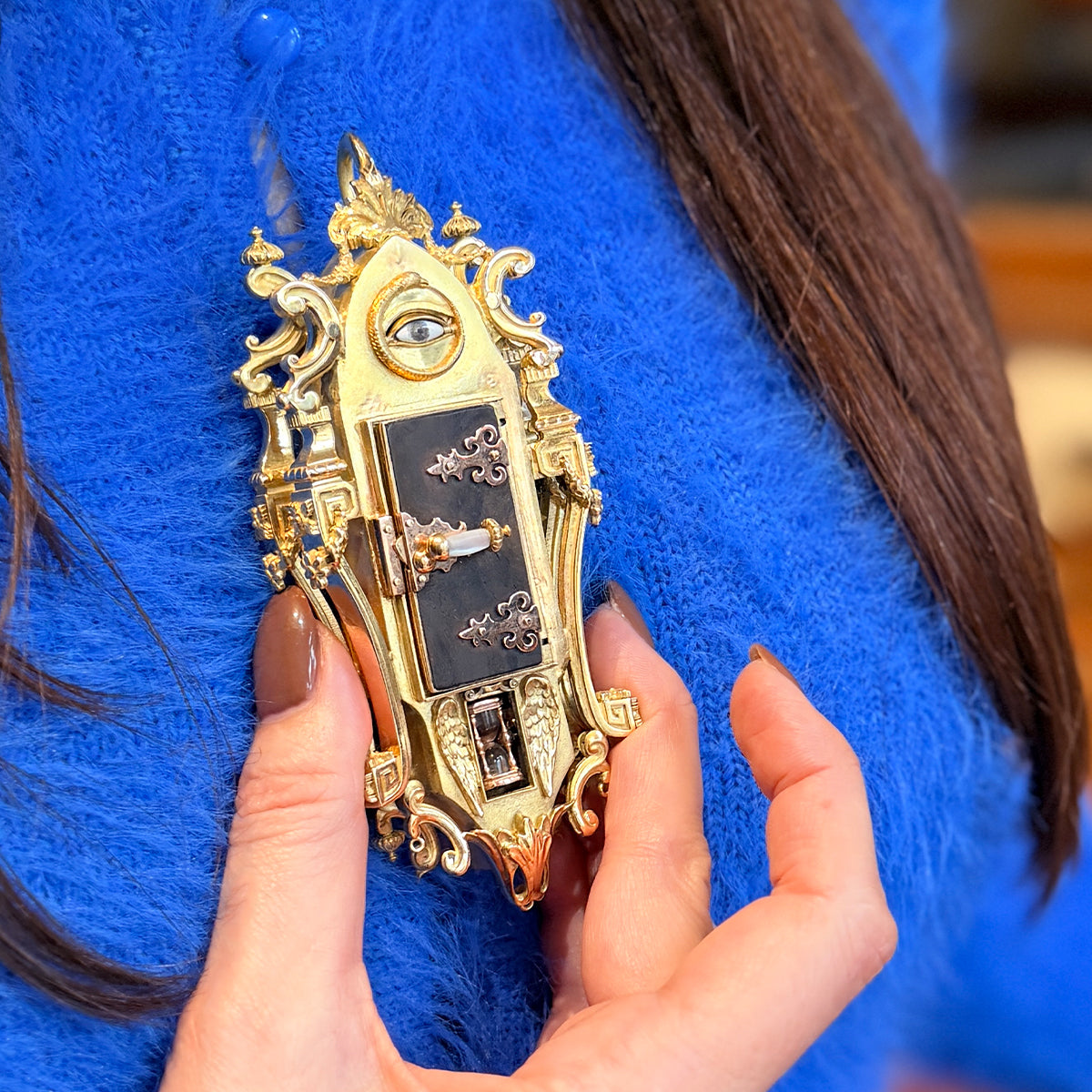
His fascination with mechanical jewellery is not new, but a recent series began with a collector in Los Angeles who has a particular fondness for objects with moving parts. William’s latest creation is a small, three sided piece with a door. Open it and the scene inside changes; close it and it returns to its original state. When a friend examined the piece, he admired the mechanism but asked, what about the back? William’s response was to make a second door, revealing the workings within.
The inspiration for these pieces reaches much further back. During his time in Geneva, William visited the Patek Philippe Museum, where he found himself drawn to the singing bird boxes and automata once commissioned by royal families as elaborate gifts. It is this tradition that fascinates him: intricate mechanisms concealed within beautiful objects, made at extraordinary effort for the private delight of their owner.
William is less sentimental about what makes this kind of craftsmanship significant today.
"In the years before AI, someone was going to have to work it out."

Memento mori as biography
The skulls, banners and cathedral ceilings that recur throughout William’s work read as Gothic in style until you spend a morning with him, at which point they begin to read as biography.
His mother kept religious objects around the house when he was growing up. William is not religious himself, but the imagery stayed with him, and he still travels to seek out cathedrals, particularly in Venice. He is especially drawn to churches built in the aftermath of plagues, when survivors marked their deliverance by erecting elaborate basilicas.
One of the clearest expressions of this fascination is a ring William created with American gem artist Dalan Hargrave, who carves into the pavilion of a gemstone so that the image reveals itself through the table when viewed from above. William’s brief was characteristically direct: he wanted to look into the stone and see the ceiling of a cathedral. Hargrave carved an elaborate vaulted ceiling, cherubs and all, into the back of the gem, creating the illusion of peering into an architectural interior. When the stone returned, it was so wide that William had to build a suitably monumental ring around it.
Back in his Melbourne studio, Melanie Katsalidis suggests that a piece like this belongs on the hand of an archbishop. William has another candidate: Ozzy Osbourne.

Then there is Spitalfields, William’s London studio overlooking the market. When the building next door was demolished, a burial ground was uncovered beneath it. From his studio window, William could see a vast collection of human remains, separated from the bustle of the market by little more than a fence.
His awareness of mortality, however, began much earlier. As a young man in New Zealand, William was involved in a head on collision while driving between towns. He spent the following six months in hospital.
“It makes you realise how close it is,” he says of death.

1977, and a walking stick for Billy Idol
Griffiths began making jewellery in 1977, aged seventeen, on a factory production line in New Zealand making wedding rings. He was bored, by his own account not very good at it, and did not last long. But the job, found through a newspaper advertisement, gave him his first foothold in the trade.
In 1978, he travelled to London to be a punk. The reality, as he tells it, was somewhat less rebellious: he was too shy. He would make his way to King’s Road, where the punks gathered, largely keeping to himself and seeing as many bands as he could. It was, he says, a very good time to be there.
Jewellery followed him to London. In Hatton Garden, he worked under a master jeweller who took him under his wing, partly because the apprentices he was supposed to be teaching would not listen. William did, and much of that knowledge found its way to him instead. Over the next two decades, he packed up his tools and moved between London and Auckland more times than he can now count. Along the way, he made pieces for an Auckland antique dealer, an experience that immersed him in the decorative language and techniques of antique jewellery that still surface throughout his work.
A little over twenty years ago, William found himself back in London and unhappy. His mother had moved to Melbourne, so he followed, sleeping on her couch until he found his feet. His first job in the city was with jeweller Ken Gray, whose workshop was known for exacting standards and where a great deal of antique jewellery passed across the bench.
The 1990s, meanwhile, were defined by silver, often in the form of enormous knuckleduster rings. One piece from the period, a ball covered in spikes, later appeared in a New Zealand court record after its owner used it to defend herself from an attacker. William also made jewellery for musicians during these years, Nick Cave among them, but much of this happened before digital photography became commonplace, leaving remarkably little of the work documented.
One commission he remembers particularly well was a walking stick made for Billy Idol, a job that came with tickets to his show. Standing in a packed stadium, William watched as Idol picked up the stick mid set and began swinging it around his head. William spent the rest of the performance thinking about one thing: he had glued the top on only twenty four hours earlier.

Our thanks to William for welcoming us into his studio and sharing the stories, tools and processes behind his work.
Explore William's collection online or book an appointment at our Russell Place gallery to discover his intricate works in person.
For more from our visit to William’s Melbourne studio, head to our Instagram.
