In The Studio With Troy Emery as he creates 'The Neighbour' for Tidal Wave

"Maybe This Is a Pearl Cat" - Troy Emery’s 'The Neighbour'
Invited to paint on a baroque pearl for Tidal Wave, Troy Emery took the brief somewhere entirely unexpected. Melanie Katsalidis visited his Brunswick studio to see what she had started.
For centuries, Europe made sense of the natural world through a curious mixture of observation, imagination and guesswork. Narwhal tusks were traded as unicorn horns, while the unusual forms of irregular pearls invited imaginative interpretations. A pearl might suggest the chest of a lion or the legs of a cat, with a goldsmith constructing the rest of the creature around its natural shape.
Troy Emery loves this. "Maybe this is a pearl cat," he says, standing over The Neighbour, the creature he created for Tidal Wave. "Or some kind of pearl growth happening on this figure." Something cryptozoological, catalogued by someone who guessed.
The invitation had arrived from Melanie Katsalidis earlier in the year: nine Australian artists, baroque pearls for each, and a brief to paint directly onto them. Emery was the only one who did not. "I do need to admit that when invited to take part in Tidal Wave, I didn't quite read the brief as thoroughly as perhaps I was intended to," he says. However, Melanie was delighted. "Working with artists from outside the jewellery world was the point of the exhibition," she says, "and then getting to see where they take it."
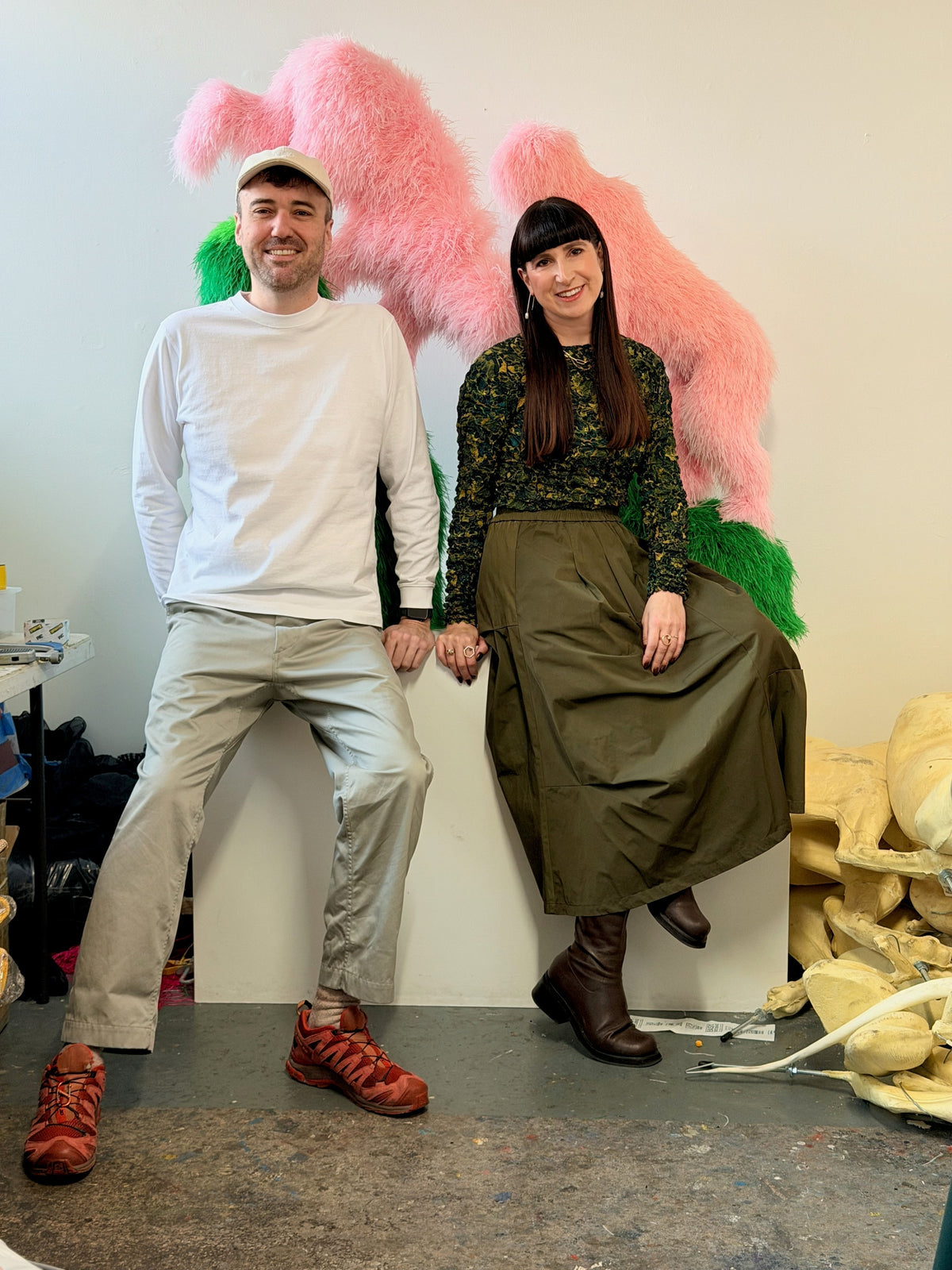
So, in July, Melanie made her way to Emery’s Brunswick studio. It was in one of its fuller phases that morning, materials gathering in one corner, works in another. The space continually shifting from week to week. Emery described it as "an evolving mess that fills up, empties out and fills again." "Like a tide," Melanie offered, an observation that, for this particular exhibition, felt more fitting than either of them could have planned.
Covering forms is central to Emery’s practice. His creatures are built up, then buried beneath mass produced craft materials: hundreds of metres of tassels, thousands of pom poms and, more recently, glass beads. “It’s all about volume,” he says of a process he calls fake taxidermy. Beginning with polyurethane mannequins made for the American hunting trade, Emery rebuilds their forms before wrapping, pinning, gluing and stapling each new surface into place. What emerges is a new skin for an animal that was never there.
The Neighbour (2026) is four-legged, faceless and completely obscured beneath long black glass bead fringing, with twenty-nine baroque pearls scattered throughout. Emery had planned to cluster them at the throat, but changed his mind - "gathered at the neck they would have read as a growth. Scattered, they read as markings." "It looks properly adorned then," Melanie said, turning it. "It's a coat."
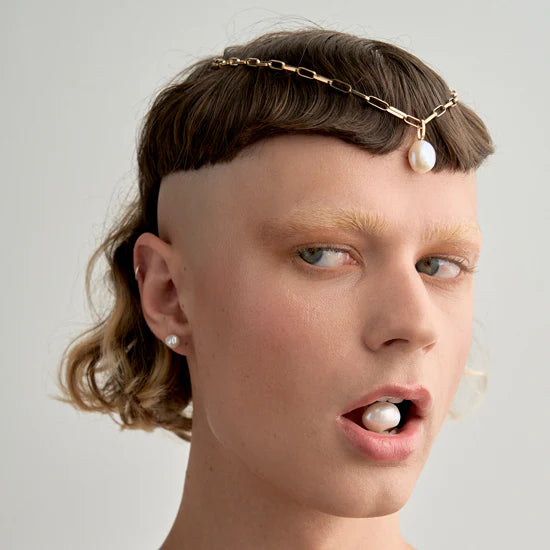
The pearls measure close to five centimetres across, “almost like a poached egg,” as Troy puts it, a comparison less irreverent than it first sounds. Baroque pearls are defined by their irregularity, and it is precisely this departure from perfection that interests Emery. “The fashion is for the perfect pearl, and that is the valued one,” he says. “And then these are somehow the discarded pearls that don't fit in that category. Whereas maybe historically the baroque pearl was the special pearl, and the round pearl was just the generic version.”
It is this inversion that gives the work its logic. The Renaissance goldsmith began with a pearl and imagined an animal around it. Emery begins with the animal and covers it in pearls, sending the guesswork in the opposite direction: not what creature does this pearl resemble? but what kind of creature might grow these?
Real pearls are also new to him. Early in his practice he used plastic ones. "The pearl is really the antithesis of a pom-pom," he says. "But it's still functionally the same. It's a thing that gets stuck on a form, or on a body, or on a garment, and it serves the same purpose. I really like that duality between high and low."
What the project has opened up, he says, is a new way of thinking about scale and surface. The Neighbour is built from black glass bead fringing, with twenty nine baroque pearls scattered through the form like unexpected points of light. Emery describes his practice as colliding elements of the decorative arts with a contemporary art mode of display. Pearls have belonged to the decorative realm for centuries. Here, set against the dense black fringe, they are pulled into something stranger, more sculptural and distinctly his own.
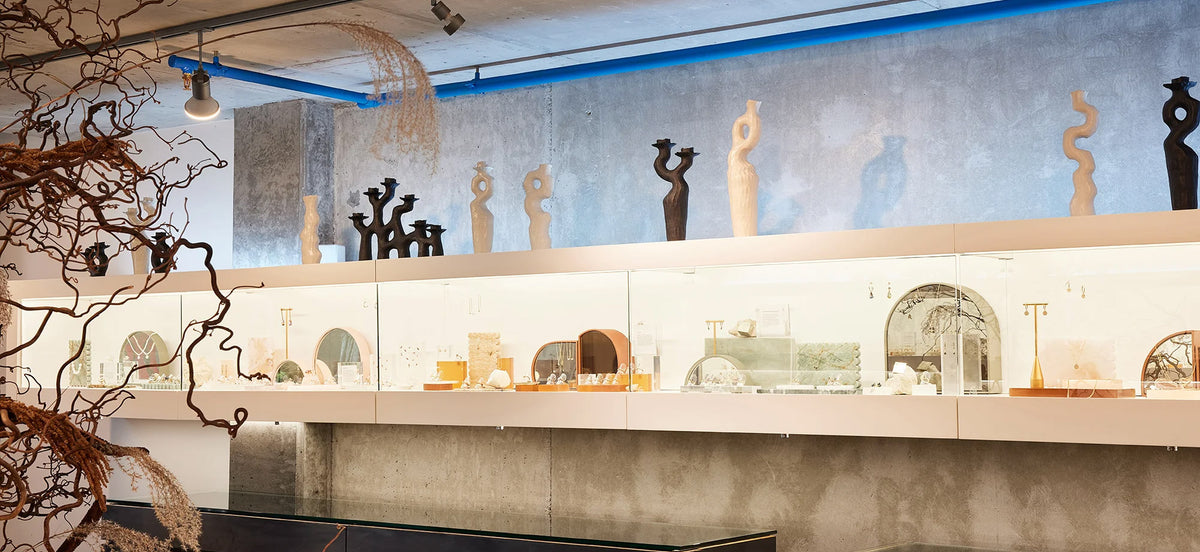
Tidal Wave runs 13 to 29 August 2026 at Pieces of Eight, 28 Russell Place, Melbourne.


Read more

A client wrote to tell us her partner had proposed in New Zealand. The stunning sapphire ring he chose came from Tessa Blazey's Kindred Spirits exhibition.

Maddie inherited a marquise Australian opal she never wore. Over ten weeks, jeweller Shimara Carlow reset it into a ring for a twenty-first birthday — and for the decades after it.