


Why I Adore The Australian Parti Sapphire
Words by Melanie Katsalidis
Every gemstone I have picked up in over twenty years of doing this has taught me something, but only one has stayed on the bench the whole time: the Australian parti sapphire. It is the stone I return to more than any other, and most people have still never heard of it.
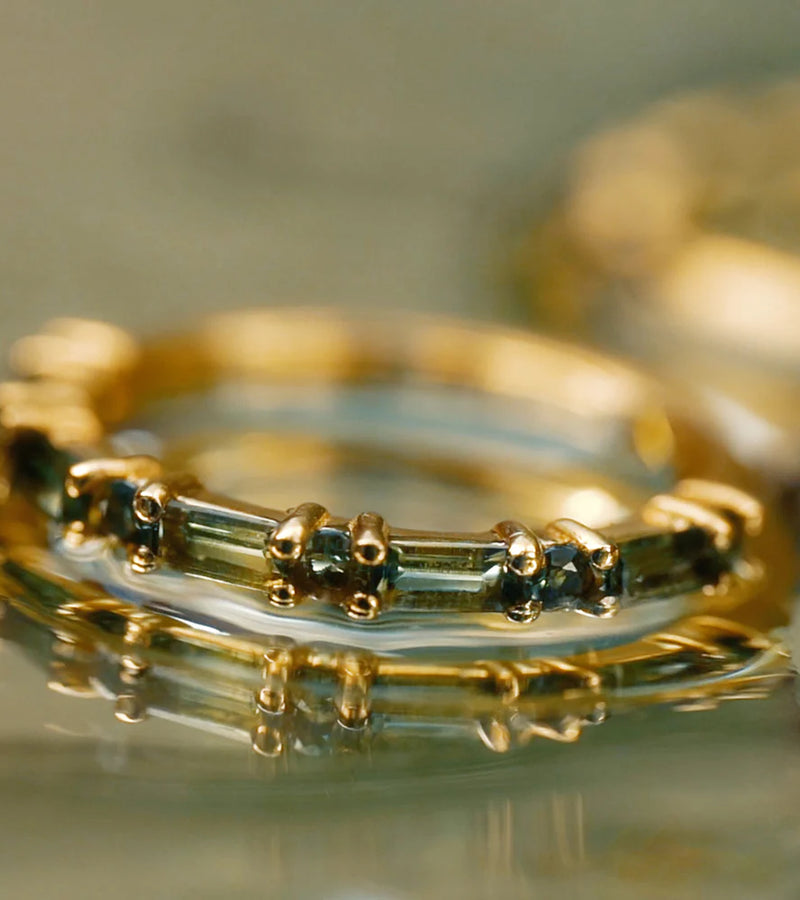
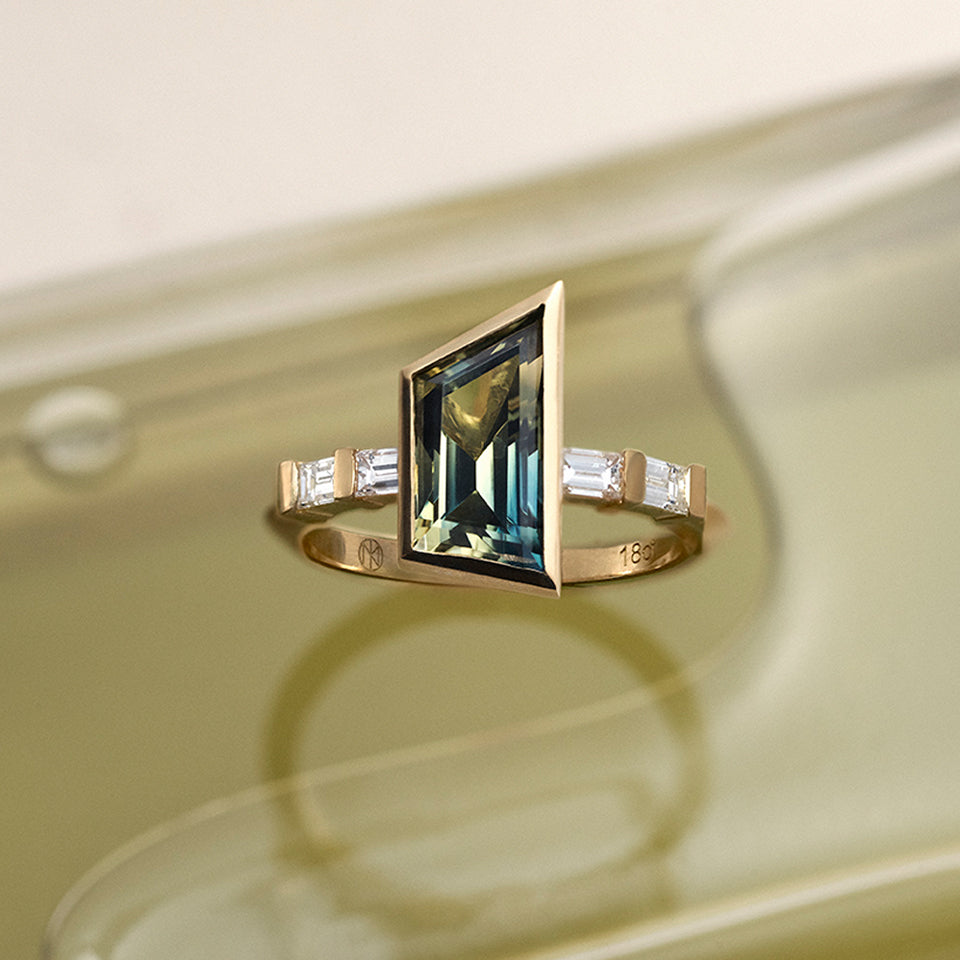
Parti is short for partition. A parti sapphire is a single stone that holds two or three colours at once, banded through the same crystal rather than mixed. Green running into blue; blue into golden yellow; or sometimes all three, shifting as the stone turns in the light. It is not a treatment and it is not a trick of the cut. The colour zoning happened in the ground, over millions of years, long before anyone touched the stone, which is exactly why it cannot be faked or grown to order in a lab.
Sapphire itself is a form of corundum, aluminium oxide, and on its own it has no colour at all. What gives it colour are tiny traces of iron and titanium caught in the crystal as it grew. In a parti sapphire those traces were not evenly distributed while the stone was forming, so instead of one even colour you get zones. Australia's sapphires are found along old river gravels in central Queensland, in gemfields around three small towns with wonderful names: Rubyvale, Sapphire and Anakie. After forming deep underground, the sapphires were carried up by ancient volcanic activity, and then spent millions of years working their way into the riverbeds where miners find them today.

I fell for them because they remind me of this country: the ocean, the sky and the earth, all held in one stone. And because no two are ever the same, every piece of jewellery I build around one is, by nature, one of a kind.
Over the years I have taken trips to the gemfields to buy directly from the people who mined the stones, sitting at trestle tables at the local gem fairs with miners, cutters and dealers I have known for years, tipping parcels of rough onto a cloth and deciding on the spot. Before a cutter touches it, rough sapphire looks like nothing at all: a dull, waterworn pebble, easy to mistake for a piece of gravel. You hold it up to the light to see what is actually inside it - the colour bands, the clarity, the shape hiding under the skin - and then you hand it to a cutter and wait. A stone can lose more than half its weight in cutting, and a colour band you loved can end up exactly where the cut needs to go. That uncertainty is part of what I love about working with them.

Most of the parti sapphires I use are cut here in Australia, by cutters I have worked with for years, which is rare in an industry where most stones are cut overseas at volume. Working directly with someone means we can talk through each stone together: whether to chase a perfect round, or follow the shape of the rough into a freeform hexagon or a long baguette. Some of my favourite pieces have come from exactly that conversation, cuts that follow the crystal instead of forcing it.
I also like knowing where my stones come from. Australian sapphire mining is still mostly small operations; individuals and families working their own claims by hand, digging down to old gravel layers and washing the stones out much as it has been done for generations. Buying direct means I know whose claim a stone came from, and that the money for it stays with the people doing the work.

On the Moh's hardness scale sapphire sits at nine, with only diamond above it, which is why I am happy to set one in a ring that will be worn every single day for decades. It also carries some lovely folklore: an ancient Persian legend held that the whole earth sat on a giant sapphire, and that is why the sky is blue. I am not superstitious, but there is something fitting about a stone with the sky and the earth banded through it carrying that story.
Every so often the gemfields remind you what they are capable of on a much larger scale. The Tomahawk Tiger, found in a Queensland creek in 1976 and weighing around eighty three carats, is technically a parti sapphire too: the same green and gold banding I love in a one carat stone, just on a scale that is nothing short of impressive. I have held it, when one day I was walking from my motel to the gem fair, and it's humble owner pulled it out of his pocket and placed it in my hand. I've never forgotten it! You can read more about this unique gemstone in a Journal story here.

My own work is geometric: clean lines, strong shapes, baguettes, hexagons and right angles. A parti sapphire gives me all the drama I need in the colour alone, so the setting can stay quiet and architectural and let the stone do the talking. That balance - one stone carrying two or three colours against a setting that holds still - is the thing I keep coming back to.

If you are choosing one for yourself, forget the grading chart a diamond would send you to. Look for colour you love rather than colour you think you should love, turn the stone to see how it moves, and think about where the colour sits before you commit to a design. Come in and my team and I can take you through our best pieces and my personal collection of loose stones. Sharing my love of gems is still my favourite part of the job.
