
Geometric Diamonds: Architecture in Artistry
There is a moment, when you hold a well-cut geometric diamond up to the light, where architecture and gemmology become one and the same thing. Facets cascade like building facades. Angles redirect light the way a thoughtful city planner redirects foot traffic. The stone becomes a tiny, perfect structure — rigorous in its geometry, alive in its luminosity. No contemporary jeweller understands this convergence quite like Melbourne-based artist and designer Melanie Katsalidis.
Melanie describes her practice as one of creating objects of quality that honour rare and precious materials — enduring pieces that transcend trends and time. And nowhere is that philosophy more visible than in her treatment of diamonds. Rather than simply setting stones in traditional ways, she interrogates the geometry of the diamond itself, placing it in dialogue with the architectural forms that underpin all great design.
This is not merely an aesthetic preference. It is a deeply considered philosophical stance, one with rich precedent in the history of design. The Bauhaus movement of the early twentieth century similarly championed the primacy of basic geometric forms. Architects from Mies van der Rohe to Le Corbusier built entire careers on the expressive power of right angles, clean planes, and structural honesty. What is remarkable about Melanie is that she has translated this tradition — usually expressed at the scale of buildings and furniture — into objects you can wear on your finger.
What Makes a Diamond "Architectural"?
In fine jewellery, a diamond's cut is its architecture — the system of flat planes (facets) deliberately arranged by a cutter to maximise the way light enters, bounces internally, and exits the stone as brilliance, fire, and scintillation.
Traditional diamond cutting — the round brilliant cut, developed to mathematical perfection in the early twentieth century — prioritises the maximum return of light to the viewer's eye above all else. It is engineering of the most refined kind, with 57 or 58 precisely calculated facets. But architectural jewellery design, as practised by artists like Melanie, often looks to cuts that foreground geometry and structural form rather than pure sparkle. These are the cuts that make a diamond look like a tiny building, a crystal, a minimalist sculpture.

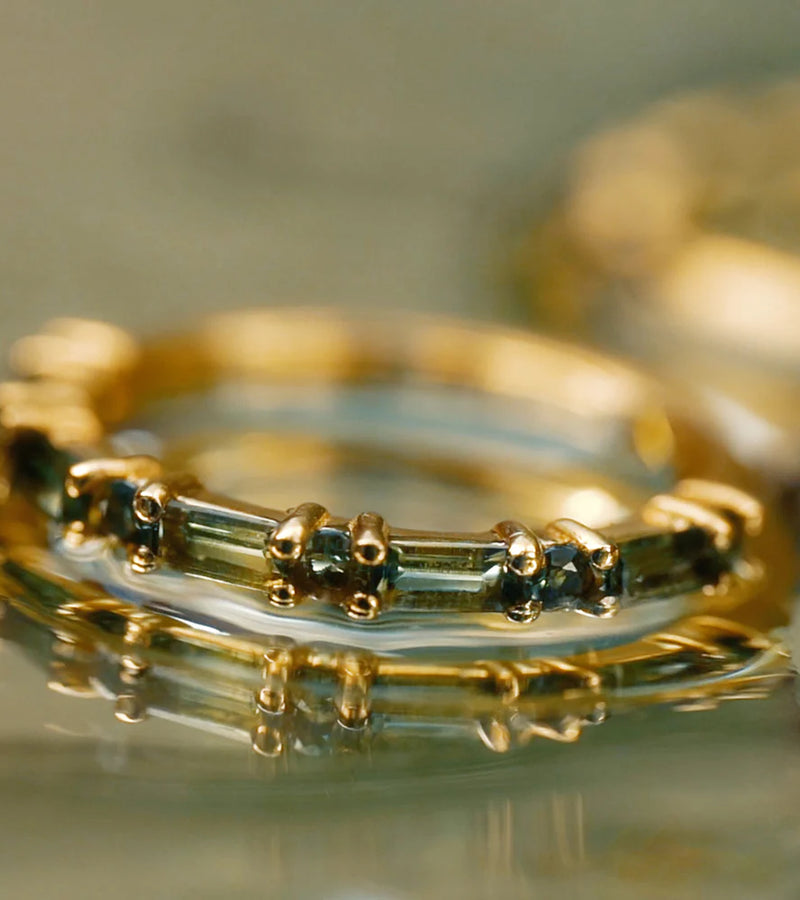
The Baguette is perhaps the most architecturally pure of all diamond cuts. It has a small number of flat, step-cut facets arranged in parallel rows, offering a cool, glassy, architectural clarity — like looking through a window into a room of mirrors. Melanie makes extensive use of baguette diamonds throughout her work. Her Double Diamond Baguette earrings, Triple Diamond Baguette variants, and Five Stone Diamond Baguette ring all deploy this cut with a modernist's conviction, lining the stones up like the windows of a Mies van der Rohe facade, each one clean, resolved, and perfectly proportioned in relation to its neighbours.

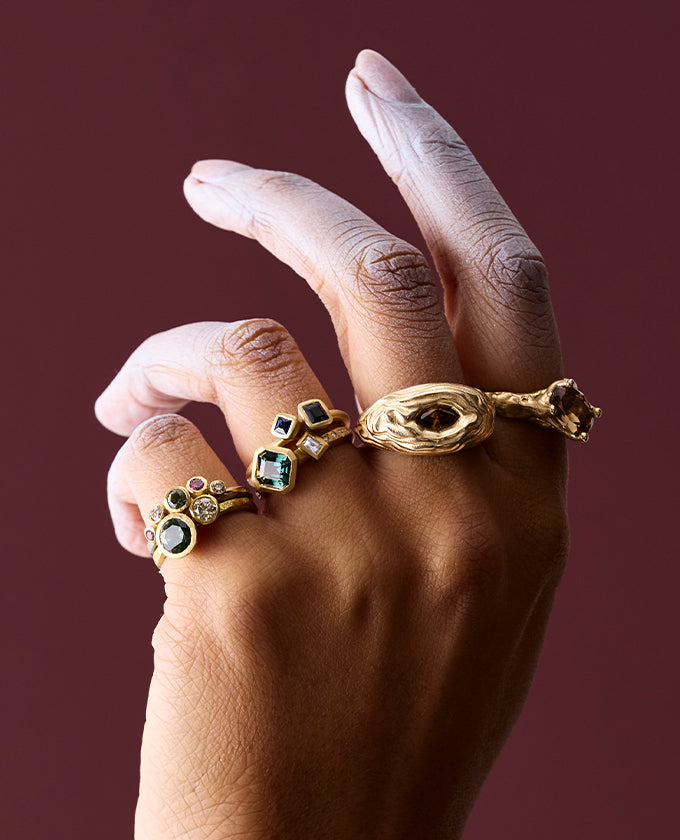
The Hexagonal Cut deserves particular attention in Melanie's work. The hexagon is one of nature's most efficient shapes — found in honeycomb, snowflakes, and basalt columns. Melanie's Hexagonal Step Cut Elevate ring takes a hexagonal diamond and elevates it — literally, on a raised architectural setting — to create a centrepiece that reads as sculpture as much as jewellery. The step faceting within the hexagonal outline gives the stone a layered quality, like the floors of a building seen from above.
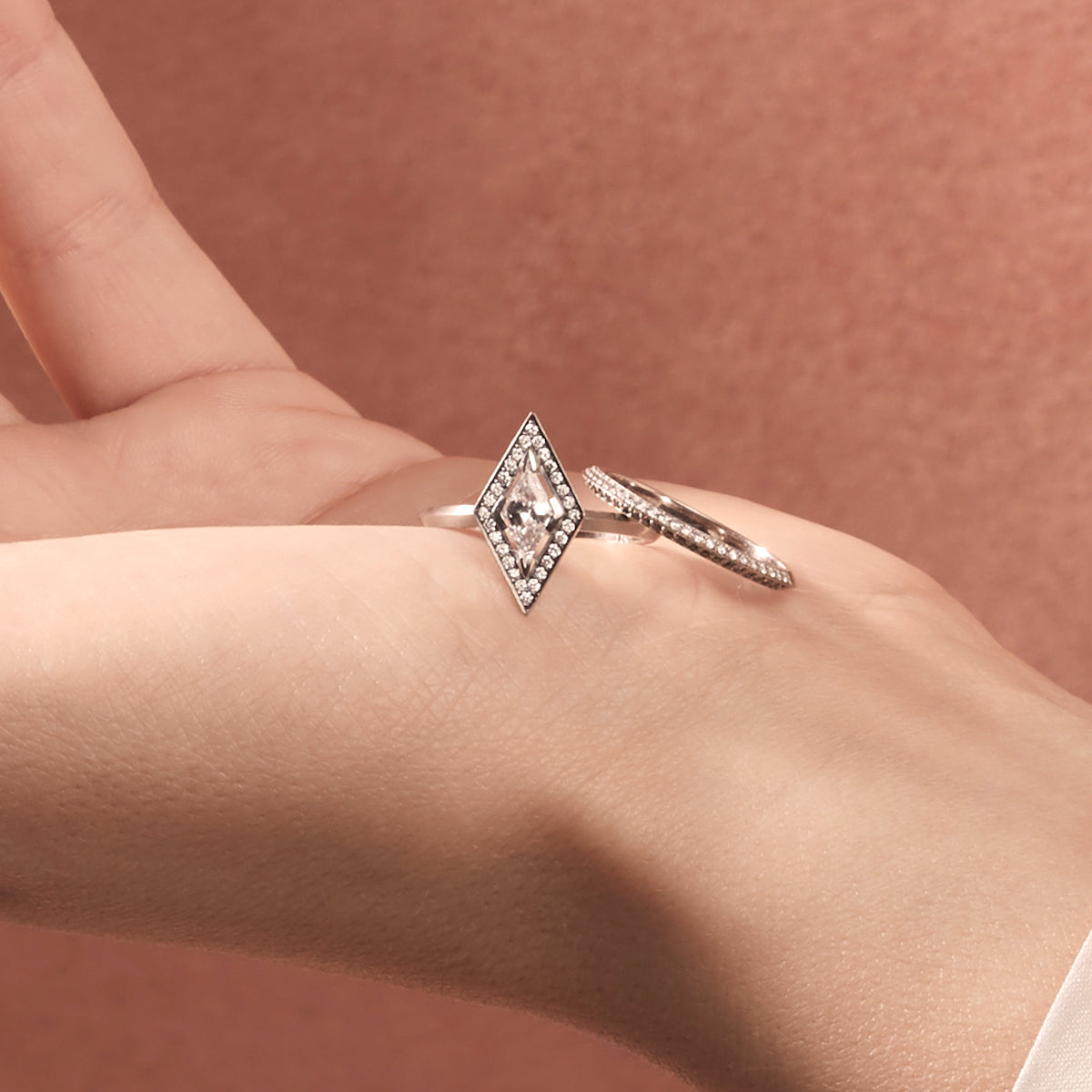
The Kite Cut is less common and more adventurous — a four-sided stone with two acute and two obtuse angles, like a child's kite or a parallelogram tilted on its axis. Melanie's Kite Diamond Elevate Halo ring makes the most of this unusual geometry, surrounding the kite-shaped centre stone with a halo that emphasises, rather than softens, the angularity of the cut. It is a genuinely architectural choice: the stone's shape dictates the design of the entire piece, just as an irregularly shaped building site demands a particular architectural response.

The Modified Hexagonal cut appears in another of her Diamond Elevate rings — a reminder that geometry in jewellery, as in architecture, need not be rigid. Modifications and variations on primary forms are where individuality enters. A hexagon with altered proportions, a softened corner, or a different faceting arrangement is still fundamentally hexagonal in its logic, but now it carries a signature.

The Skyline: Architecture Made Wearable
The Skyline collection uses baguette cut diamonds arranged at varying heights to create a rhythmic, stepped profile that genuinely reads like a city skyline. These pieces make the connection between jewellery design and architectural thinking explicit. The design is essentially a small urban elevation — drawn not in pencil on paper, but in white diamonds set in gold.

Settings as Architecture
A diamond's cut is only half the story. The setting — the metalwork that holds the stone — is equally an architectural act. Melanie treats settings with the same rigour she brings to stone selection. Her Elevate series literally raises the stone on a structured platform, creating a three-dimensional profile that changes how the piece interacts with light and space as the wearer moves. This is fundamentally architectural thinking: the stone is a room, and the setting is the building around it.
Why This Matters: Jewellery as Enduring Design
There is something important in the alignment between architectural thinking and jewellery making that goes beyond aesthetics. Buildings are meant to last generations. So, at their finest, are jewels. Melanie is captivated by the idea of jewellery as a personal touchstone — a piece worn and treasured for years, carrying the wearer's history and spirit as it's passed to the next generation.
This is precisely why geometric and architectural forms suit fine jewellery so well. Trends are cyclical; geometry is eternal. A round brilliant diamond set in a six-claw solitaire will always look of its era. A baguette-cut stone set in a clean geometric composition transcends the decade of its creation in the same way that the best modernist buildings do. They are not timeless because they are neutral — they are timeless because they are resolved. Every decision has been made with intention, and the result has a clarity that does not date.
A Primer for the Collector
If you're approaching Melanie's geometric diamond jewellery for the first time, a few practical concepts will enrich your understanding of what you're looking at:
Step cuts versus brilliant cuts — Step cuts (baguette, emerald, hexagonal) emphasise the architectural geometry of the stone through flat, parallel facets. Brilliant cuts (round, cushion, pear) maximise light return through a complex arrangement of triangular and kite-shaped facets. Both are beautiful, albeit in different ways.

The role of inclusions — In step cuts, because the large open facets allow you to look deep into the stone, clarity matters more than in brilliant cuts. Melanie's use of salt and pepper diamonds reflects a conscious decision to find beauty in what traditional grading systems would classify as imperfect.

Setting height and profile — Melanie's Elevate settings raise diamonds off the finger, giving them an architectural presence in three dimensions, not just two. This changes how you relate to the stone: it becomes an object to be regarded from multiple angles, not just glimpsed in passing.

Metal choice — Yellow gold warms a cool white diamond; rose gold adds a romantic flush; white gold or platinum lets the stone speak for itself. Across her diamond collection and bespoke commissions, Melanie deploys all three, always with intention.
Conclusion
In the hands of Melanie Katsalidis, a diamond is never merely a diamond. It is a study of geometry, a miniature building, a resolved formal composition. Her work reminds us that the most ancient shapes — square, triangle, circle and hexagon — remain the most vital. They do not need embellishment. They need only precision, care, and the right material.
That material, at its finest, is a diamond: formed over billions of years in the earth's mantle, cut by human skill into something that can hold and return the light in ways that feel slightly miraculous. When architectural thinking meets that kind of material, the result is jewellery that earns its place not just in a collection but in a life — worn, inherited, and worn again.
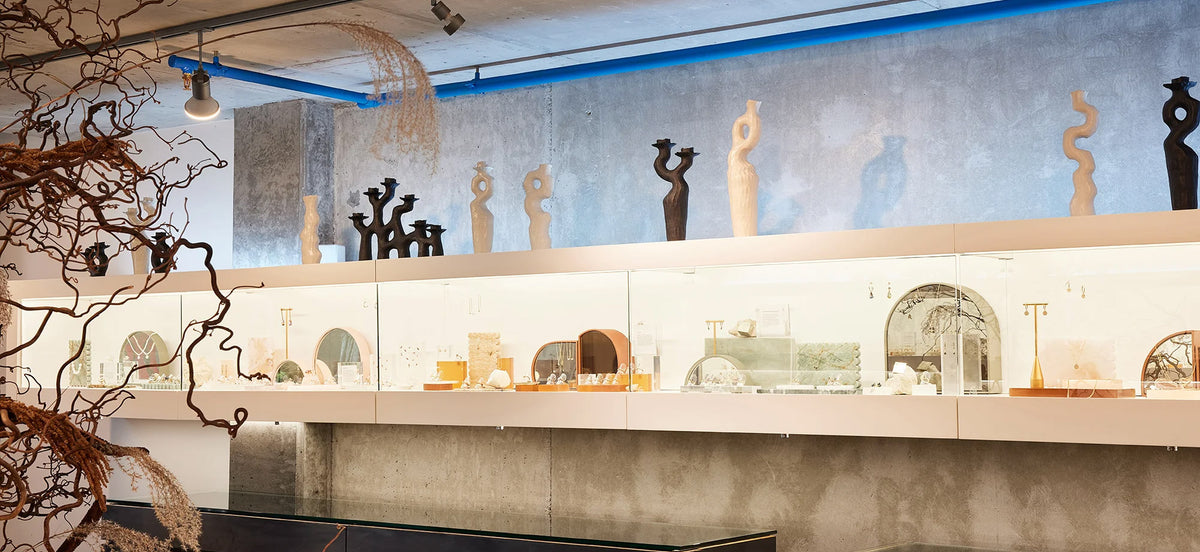
Melanie Katsalidis's work can be explored at Pieces of Eight Gallery at 28 Russell Place, Melbourne, or online. Bespoke commissions are also available for those wishing to work directly with the artist on their own geometric vision.

Read more

The Architecture of Home and Heritage There are places that do more than shelter us; they shape us. For Melanie Katsalidis, the family beach house at St Andrews Beach is one such place. Completed i...

A Living Gem: Why Pearls Need Care Unlike harder gemstones, pearls are soft and organic — born from a living creature and built from delicate layers of nacre. This gentle nature is the source of t...